

Download our SSCE Study Guide Bundle
Chapter 22 Summary of To Kill a Mockingbird
Chapter 22 of To Kill a Mockingbird opens immediately following the guilty verdict against Tom Robinson. Jem is devastated. He walks home with tears streaking his face, repeatedly muttering, “It ain’t right.” Atticus solemnly agrees with him. When they return home, Aunt Alexandra is waiting up and uncharacteristically expresses sympathy, calling Atticus “brother.” Jem is deeply distressed. He asks his father how the jury could do such a thing. Atticus replies that he doesn’t know, but “they’ve done it before and they did it tonight and they’ll do it again and when they do it—seems that only children weep.”
The next morning, the Finch family wakes up to an astonishing sight in their kitchen. The table is overflowing with food: a chicken from Tom Robinson’s father, rolls from Estelle at the hotel, salt pork, tomatoes, beans, scuppernongs, and pickled pigs’ knuckles. Calpurnia explains that the Black community left the food on the back steps that morning to show their appreciation for Atticus’s genuine effort to defend Tom. Deeply moved, Atticus’s eyes fill with tears. He asks Calpurnia to tell them he is very grateful, but to beg them never to do it again because “times are too hard” during the Depression.
Later that morning, Dill comes over and shares that his Aunt Rachel made a cynical comment about Atticus “butting his head against a stone wall.” When the children go outside, they see Miss Stephanie Crawford gossiping with Mr. Avery and Miss Maudie. Instead of indulging Miss Stephanie’s nosy questions about the children sitting in the Colored balcony, Miss Maudie invites Jem, Scout, and Dill inside for cake.
In a quiet but highly symbolic gesture, Miss Maudie bakes only two small cakes for Scout and Dill, and cuts Jem a slice from the big cake. She tells Jem not to fret because “things are never as bad as they seem.” She explains that Atticus is one of those men “born to do our unpleasant jobs for us.” When Jem expresses disillusionment with the people of Maycomb, Miss Maudie points out that Atticus actually had quiet support from the town’s fair-minded citizens. She reveals a crucial piece of information: Judge Taylor deliberately appointed Atticus to defend Tom Robinson. Normally, court-appointed cases went to a junior lawyer who needed experience, but Judge Taylor purposely gave it to Atticus because he knew Atticus would actually fight for Tom. Miss Maudie points out that keeping a racist jury deliberating for hours instead of returning an immediate guilty verdict is a “baby-step” towards progress.
Disillusioned by the cruelty of the adult world, Dill declares that when he grows up, he wants to be a new kind of clown—one who stands in the middle of the ring and laughs at the audience.
The chapter ends on a cliffhanger. Miss Stephanie and Miss Rachel wave the children over to deliver shocking news: that morning at the post office corner, Bob Ewell stopped Atticus, cursed at him, spat in his face, and threatened that he would “get him if it took the rest of his life.”
Analysis of Chapter 22
This chapter of To Kill a Mockingbird is the climax of Jem’s coming-of-age arc. His tears over the verdict represent the shattering of his idealised view of Maycomb. He realises that the justice system and the people he previously respected are infected by deep, irrational prejudice. Miss Maudie acknowledges Jem’s transition into young adulthood by cutting him a slice from the “big cake” instead of giving him a little cake like Scout and Dill. She treats him not as a naive child, but as a young man capable of understanding the harsh realities—and the subtle victories—of the adult world.
Harper Lee uses Miss Maudie as a moral guide to help the children (and the reader) process the tragic outcome of the trial. While Jem only sees complete defeat, Miss Maudie provides perspective by pointing out the significance of the jury taking hours to convict a Black man accused of raping a white woman in the 1930s South. Furthermore, her revelation that Judge Taylor intentionally stacked the deck by assigning Atticus to the case proves that Atticus does not stand entirely alone. There is a hidden network of “people with background” who are slowly pushing Maycomb toward justice.
The mountain of food left on the Finches’ back steps is one of the most touching scenes in the novel. During the Great Depression, food was incredibly scarce, especially for the marginalised Black community. Their willingness to part with their valuable resources is a profound testament to their respect for Atticus. They know he lost the case, but they recognise that he did something unprecedented: he treated Tom Robinson as a human being and fought for him with total integrity. Atticus’s tears demonstrate his deep empathy and his understanding of the immense sacrifice behind their gifts.
Dill’s reaction to the injustice is to detach himself through cynicism. By deciding he wants to be a clown who laughs at people, he is trying to build a psychological defence mechanism against the “simple hell people give other people.” He wants to mock the absurdity and cruelty of society rather than let it break his heart as it broke Jem’s.
Bob Ewell’s threat at the end of the chapter shifts the narrative focus. Even though Ewell won the legal battle, Atticus completely destroyed his credibility and exposed him as an abusive liar during the trial. Because Ewell knows the town didn’t truly believe him, his pride is fatally wounded, turning him into a dangerous, vindictive threat. This incident sets up the physical danger that will drive the plot toward its final, violent conclusion.
Chapter 23 Summary of To Kill a Mockingbird
Chapter 23 of To Kill a Mockingbird opens with the aftermath of Bob Ewell spitting in Atticus’s face, cursing him, and threatening his life at the post office corner. According to Miss Stephanie Crawford, Atticus simply wiped his face, let Ewell call him names, and calmly walked away. When Jem and Scout express deep fear for his life and beg him to carry a gun, Atticus refuses. He explains his reasoning to Jem by asking him to stand in Ewell’s shoes: Atticus destroyed Ewell’s last shred of credibility at the trial, and Ewell needed to take his anger out on someone. Atticus states he would rather take the brunt of Ewell’s fury than have Mayella suffer another beating.
The conversation shifts to Tom Robinson, who is currently at Enfield Prison Farm awaiting an appeal. If he loses, he will go to the electric chair. Jem is deeply troubled by this. He argues that rape should not be a capital offense or that they should do away with juries entirely, as they convict innocent men on circumstantial evidence. Atticus agrees that the system is flawed and suggests that only judges should have the power to fix penalties in capital cases.
Atticus explains the harsh reality of their society: whenever a white man’s word is against a Black man’s, the white man always wins. He tells Jem that there is nothing more sickening than a white man taking advantage of a Black man’s ignorance, declaring that any white man who does this is “trash.”
When Jem asks why decent Maycomb citizens don’t serve on juries, Atticus explains that women are legally barred from serving to protect them from “sordid cases,” and townspeople are afraid of the economic repercussions of taking a divisive stand. However, Atticus reveals a shocking fact: the one juror who took hours to be worn down and initially pushed for an acquittal was a Cunningham connection.
Encouraged by the news that a Cunningham supported Atticus, Scout announces she wants to invite Walter Cunningham over for dinner and perhaps to spend the night. Aunt Alexandra instantly vetoes the idea. When Scout presses for a reason, her aunt bluntly states that they are not “our kind of folks” and that Walter is “trash” whose habits Scout might pick up. Scout is so infuriated and hurt by this that she bursts into tears. Her outburst forces Jem to drag her away to his room.
In his room, Jem comforts Scout and tries to show her how he is growing up by revealing a tiny patch of chest hair. He then shares a theory he has been pondering about Maycomb’s social structure. He believes there are four distinct kinds of people in the world: the ordinary folks like the Finches, the out-in-the-woods folks like the Cunninghams, the dump folks like the Ewells, and the Negroes. He explains that each group despises the one directly below it.
Scout disagrees with this complex hierarchy. She argues that “there’s just one kind of folks. Folks.” Jem sadly replies that he used to think that too, but if everyone is alike, he cannot understand why they go out of their way to despise one another. The chapter concludes with Jem having a profound epiphany: he finally understands that Boo Radley has stayed shut up in his house all these years simply because “he wants to stay inside.”
Get the Full Analysis in PDF
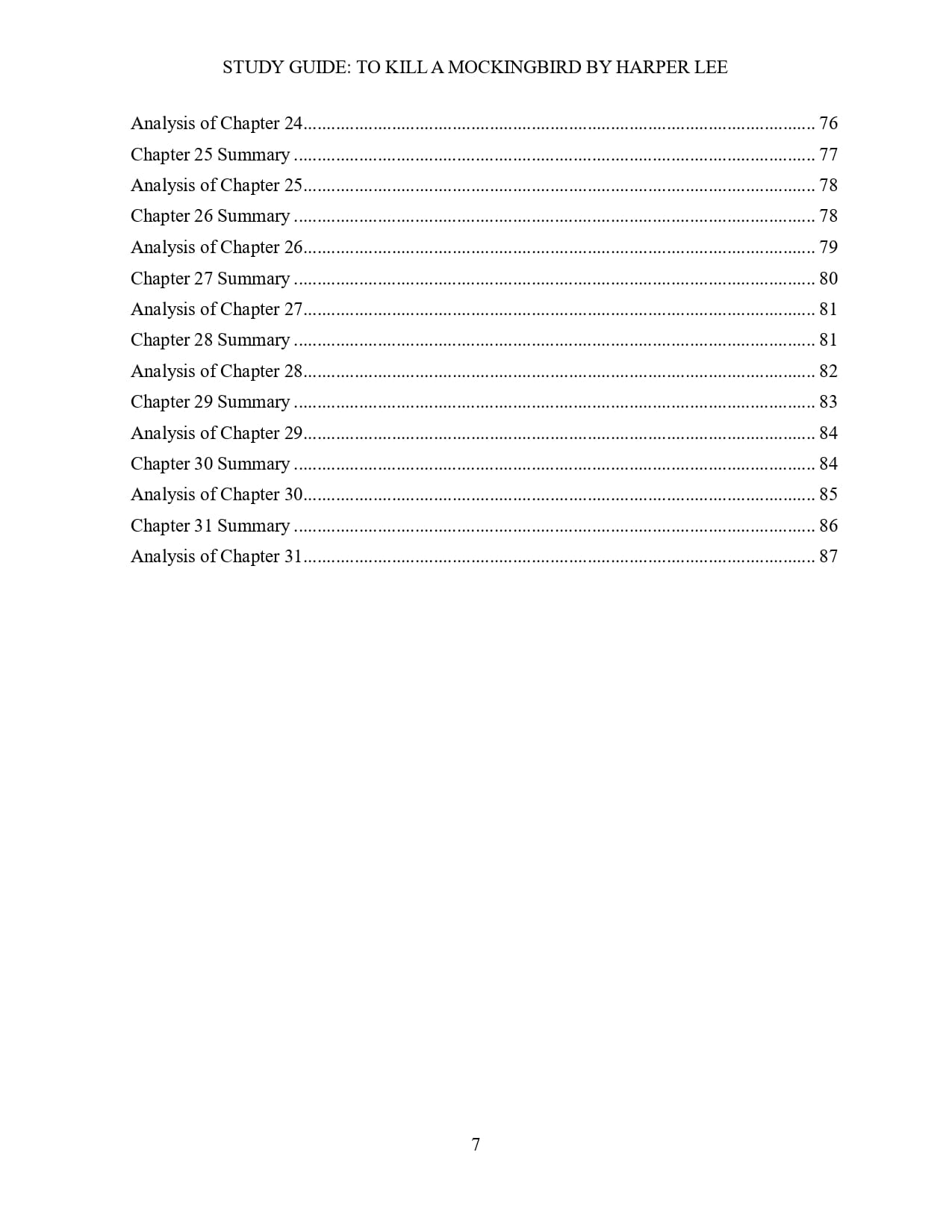
Enjoying this breakdown? What you’re reading is just part of the full experience. The premium PDF edition brings everything together in one seamless, distraction-free document that has the background, setting, plot summary, chapter-to-chapter summary and analysis, narrative devices, characters, and themes. If you’re studying seriously, this is the version you’ll want.


Analysis of Chapter 23
Harper Lee uses this chapter to sharply contrast Atticus’s moral compass with Aunt Alexandra’s class prejudice. Atticus defines “trash” purely by a person’s moral actions—specifically, a white man who exploits or cheats a Black man. In his view, character and integrity dictate a person’s worth. Conversely, Aunt Alexandra defines “trash” by socio-economic status and family background. Even though the Cunninghams are honourable and pay their debts, she refuses to let Scout associate with Walter simply because of his poverty and lack of “breeding.”
The debate between Atticus and Jem functions as a critique of the 1930s Southern legal system. Jem’s youthful idealism cannot accept that an innocent man was condemned to death by a biased jury. Atticus’s assertion that a defendant is entitled to the “shadow of a doubt” highlights the tragic reality of the trial: the jury ignored their doubts because their racial prejudice blinded their reason. Atticus’s bleak acknowledgement that the white man always wins in these situations confirms that the justice system is inherently broken when infected by racism.
Atticus once again models extreme empathy, even towards his enemies. Instead of reacting to Bob Ewell’s physical threat and vile insult with violence, he places himself in Ewell’s shoes. He recognises that Ewell’s fragile pride was shattered in court and willingly acts as a lightning rod for Ewell’s anger if it saves Mayella from being abused. This reinforces Atticus’s earlier lesson that true courage does not involve a man with a gun.
On the whole, Chapter 23 of To Kill a Mockingbird shows Jem taking on an increasingly adult perspective. He acts as a protector to Scout when Aunt Alexandra makes her cry, and he is trying desperately to make logical sense of Maycomb’s fractured society through his “four kinds of folks” theory. Scout’s innocent, egalitarian belief that people are just “folks” contrasts sharply with Jem’s growing cynicism. Jem’s final realisation about Boo Radley—that the outside world is so cruel and irrational that Boo voluntarily isolates himself from it—marks a devastating loss of childhood innocence. He is beginning to view Maycomb society as a toxic environment.
Chapter 24 Summary of To Kill a Mockingbird
Chapter 24 of To Kill a Mockingbird takes place in late August, the day before Dill is set to return to Meridian. Aunt Alexandra is hosting a meeting of her missionary circle, and Scout, wearing her pink Sunday dress, decides to stay inside and help Calpurnia serve refreshments. Scout joins the ladies in the living room and sits next to Miss Maudie. When Miss Stephanie Crawford asks Scout what she wants to be when she grows up, Scout politely answers, “just a lady.”
The conversation is dominated by Mrs. Grace Merriweather, the “most devout lady in Maycomb,” who tearfully reports on the squalid conditions of the Mruna tribe in Africa and praises a missionary named J. Grimes Everett. However, her Christian charity vanishes when the topic turns to Maycomb’s own Black community. She complains bitterly that her cook, Sophy, has been “sulky” and “dissatisfied” since the Tom Robinson trial.
Mrs. Merriweather then makes a veiled, insulting remark about Atticus. She criticises “some good but misguided people in this town” who thought they were doing the right thing but only succeeded in stirring up the Black community. Furious that Mrs. Merriweather is insulting Atticus while eating his food in his own house, Miss Maudie icily shuts her down by asking, “His food doesn’t stick going down, does it?” Aunt Alexandra quickly covers the awkward tension by passing more refreshments, shooting Miss Maudie a look of pure gratitude.
The gathering is interrupted when Atticus arrives home early. Looking exhausted and pale, he calls Aunt Alexandra, Scout, Calpurnia, and Miss Maudie into the kitchen to deliver tragic news: Tom Robinson is dead. Atticus explains that Tom was shot during the prison’s exercise period. He had made a blind, raving charge at the fence, and the guards shot him seventeen times. Atticus notes that Tom had simply given up hope on “white men’s chances and preferred to take his own.” He asks Calpurnia to come with him to break the news to Tom’s wife, Helen.
Aunt Alexandra is devastated. She sits down and tearfully asks Miss Maudie what else the town wants from Atticus, noting that doing the town’s difficult moral work “tears him to pieces.” Miss Maudie comforts her. She explains that the handful of fair-minded people in Maycomb are actually paying Atticus the highest tribute possible: “We trust him to do right.”
Aunt Alexandra composes herself, smooths her dress, wipes her eyes, and asks if she shows any signs of crying. Reassured by Miss Maudie, she proudly holds her head high and returns to the dining room to continue hosting the ladies as if nothing has happened. Deeply impressed by her aunt’s incredible emotional fortitude, Scout decides that if Aunty can be a lady at a time like this, so can she. Scout picks up a tray of cookies and gracefully rejoins the meeting.
Analysis of Chapter 24
Harper Lee masterfully uses the missionary circle to expose the glaring hypocrisy of Maycomb’s white elite. Mrs. Merriweather sheds genuine tears over the poverty of the Mrunas in Africa but remains completely blind to the suffering of the Black citizens in her own town. She demands Christian forgiveness but expects her cook, Sophy, to act cheerfully while her community is subjected to profound injustice. The ladies’ willingness to send money to J. Grimes Everett while actively participating in the oppression of their Black neighbours perfectly illustrates the moral blindness of the Jim Crow South.
The horrific details of Tom Robinson’s death—being shot seventeen times—highlight the excessive, brutal force used against Black men. Tom’s decision to climb the fence in broad daylight is an act of total despair. Having experienced the complete failure of the legal system, he realises that “white men’s chances” (the appeals process) offer him no real hope. His death symbolises the ultimate destruction of innocence by a prejudiced society.
Miss Maudie once again serves as the moral centre of the chapter. When Mrs. Merriweather cowardly insults Atticus in his own home, Miss Maudie fiercely defends him by reminding the women that they are happily eating the food provided by the man they are criticising. Later, she provides vital perspective to Aunt Alexandra by helping her understand that Atticus is not just a victim of the town’s prejudice, but their designated moral champion.
Throughout the novel, Scout has fiercely rejected the idea of being a “lady,” preferring the straightforward, logical world of her father and brother. She views the world of women as full of traps and gossip. However, witnessing Aunt Alexandra’s reaction to Tom’s death completely changes Scout’s perspective. She sees her aunt absorb a crushing emotional blow, hide her grief to protect the family’s dignity, and march back into the living room to do her duty. For the first time, Scout recognises that being a lady requires a profound, quiet courage, and she takes her first conscious step into womanhood by following her aunt’s example.
In a nutshell, this chapter reveals the hidden depths of Aunt Alexandra. Up until now, she has been portrayed as rigid, snobbish, and obsessed with appearances. Here, her genuine love for Atticus breaks through her tough exterior. Her anguish over how the town is “tearing him to pieces” humanises her and shows that, beneath her strict adherence to Maycomb’s social codes, she possesses deep familial loyalty and empathy.
Related:
- Chapter 1 to 3 Summary and Analysis of To Kill a Mockingbird by Harper Lee
- Chapter 4 to 6 Summary and Analysis of To Kill a Mockingbird by Harper Lee
- Chapter 7 to 9 Summary and Analysis of To Kill a Mockingbird by Harper Lee
- Chapter 10 to 12 Summary and Analysis of To Kill a Mockingbird by Harper Lee
- Chapter 13 to 15 Summary and Analysis of To Kill a Mockingbird by Harper Lee
- Chapter 16 to 21 Summary and Analysis of To Kill a Mockingbird by Harper Lee
- Chapter 25 to 28 Summary and Analysis of To Kill a Mockingbird by Harper Lee
- Chapter 29 to 31 Summary and Analysis of To Kill a Mockingbird by Harper Lee
Receive Literary Updates through our Social Media Channels:
- WhatsApp: Literature PADI or Literature-in-English with LP
- Telegram: Literature PADI
- YouTube: @literaturepadi
- Facebook: Literature PADI


