

Download our SSCE Study Guide Bundle
Chapter 1 Summary of To Kill a Mockingbird
Chapter 1 of To Kill a Mockingbird begins with the adult narrator, Scout (Jean Louise Finch), reflecting on the events that led to her older brother Jem breaking his arm when he was nearly thirteen. To explain the context of their story, Scout delves into her family’s history, starting with their ancestor Simon Finch, an apothecary who fled religious persecution in England and established a self-sufficient homestead called Finch’s Landing on the Alabama River. The tradition of living on the land was broken by Scout’s father, Atticus Finch, who moved to Montgomery to read law and then returned to Maycomb to practice.
Scout describes Maycomb as a tired, slow-moving, and hot Southern town suffering through the Great Depression. She notes that “there was nowhere to go, nothing to buy and no money to buy it with,” though the town possessed a vague optimism inspired by FDR’s assertion that they had “nothing to fear but fear itself.” The Finch household consists of Atticus, who treats his children with “courteous detachment,” Scout, Jem, and their stern, nearsighted cook, Calpurnia. Scout and Jem’s mother died of a sudden heart attack when Scout was two years old, leaving Jem with clear, sometimes saddening memories of her, though Scout does not miss her.
The children’s boundaries are strictly defined until the summer Dill (Charles Baker Harris) arrives. Dill, who is small for his age, highly imaginative, and capable of reading, comes from Meridian, Mississippi, to spend the summer with his aunt, Miss Rachel Haverford, who lives next door to the Finches. Dill quickly integrates into Scout and Jem’s routine of acting out plays based on books, bringing new life to their games with his eccentric plans and fancies.
Eventually, their play routines become stale, and Dill becomes deeply fascinated by the Radley Place, a dilapidated, mysterious house down the street. The house is said to be inhabited by a “malevolent phantom” named Arthur “Boo” Radley, whom the children have never seen.
According to neighbourhood gossip—primarily supplied by the neighbourhood scold, Miss Stephanie Crawford—Boo got mixed up with a rowdy crowd of teenagers who were sentenced to the state industrial school. Boo’s father, a strict and unforgiving man, considered this a disgrace and kept Boo locked inside the house for fifteen years. Legend holds that Boo eventually drove a pair of scissors into his father’s leg, but Mr. Radley still refused to send him to an asylum. When Mr. Radley died, Boo’s older brother, Nathan, took over the house and maintained Boo’s isolation.
Dill’s fascination peaks when he dares Jem to go past the Radley gate and touch the house, betting him a book. Jem, who has “never declined a dare,” hesitates for three days before finally sprinting into the yard, slapping the side of the house, and rushing back. Safe on their own porch, the children look back at the Radley house and see a tiny, almost invisible movement—the flick of an inside shutter—suggesting someone is watching them.
Analysis of Chapter 1
Chapter 1 of To Kill a Mockingbird establishes the narrative framework of the novel: a retrospective account told by an adult Scout looking back at her childhood. By opening with Jem’s broken arm and tracing the origins of the story back to Andrew Jackson and Simon Finch, the narrator highlights how deeply history, lineage, and past actions influence the present. This narrative distance allows Lee to blend the innocent, sometimes naive observations of a child with the mature, ironic insights of an adult.
Harper Lee masterfully establishes Maycomb not just as a backdrop, but as a character itself. The description of the sweltering heat, the red slop of the streets, and the slow pace of life grounds the reader in the 1930s Jim Crow South. The mention that people had “nothing to fear but fear itself” firmly places the narrative during the Great Depression. The chapter also introduces the rigid social fabric of Maycomb, demonstrated by how a family’s history dictates their standing, and how deviations from the norm—like the Radleys’ refusal to attend church or socialise—are viewed as “unforgivable.”
Boo Radley is introduced as a Gothic element, a “malevolent phantom” blamed for frozen azaleas and any stealthy crimes in the town. He represents the human tendency to demonise the unknown. The children’s view of Boo is entirely shaped by the community’s rumours which have painted him as a monster who dines on raw squirrels and has a jagged scar and rotten teeth. This introduces a central theme of the novel: the destructive nature of prejudice and gossip. The children’s treatment of Boo as a game or a ghost story highlights their innocence, but also mirrors the adult world’s marginalisation of outcasts.
Notably, this chapter introduces the key characters. It introduces Atticus Finch who is immediately established as a figure of steady morality, intellectualism, and fairness. The anecdote about his first two clients, the Haverfords, who were hanged because they stubbornly refused to plead guilty to a lesser charge, foreshadows Atticus’s future involvement in challenging and grim legal battles. Then, we are introduced to Jem who is shown to be prideful, protective of his honour, and heavily influenced by the idea of bravery, as seen when he accepts Dill’s dare despite his obvious terror. Another key character introduced in this chapter is Dill. He is the catalyst for the novel’s childhood plotline. His status as an outsider allows him to look at Maycomb’s peculiarities with fresh curiosity, and his instigation of the mission to “make Boo Radley come out” sets the narrative in motion.
Chapter 2 Summary of To Kill a Mockingbird
Chapter 2 of To Kill a Mockingbird begins in early September with Dill’s departure back to Meridian. His departure leaves Scout miserable until she realises she is finally about to start her first year of school, an event she has long anticipated. Jem walks her to school, but he lays down strict ground rules: Scout is to stick to the first grade, avoid embarrassing him with references to their private games, and essentially leave him alone during school hours.
Scout’s first-grade teacher is Miss Caroline Fisher, a twenty-one-year-old woman from Winston County in North Alabama. She is an outsider, and the class is immediately wary of her, as Winston County had famously seceded from Alabama when Alabama seceded from the Union.
Miss Caroline begins the day by reading a highly imaginative story about talking cats to a class composed mostly of ragged farm children who are completely immune to such literature. The real conflict begins when Miss Caroline discovers that Scout can already read flawlessly. Instead of being pleased, she is highly displeased and tells Scout to inform Atticus to stop teaching her, claiming that it will interfere with her reading and that it is best to begin with a “fresh mind.” Scout is confused, as Atticus never formally taught her; reading was just something that came to her naturally from sitting in his lap every night. Scout’s day worsens when Miss Caroline catches her writing a letter to Dill; the teacher reprimands her again, stating that first graders are only supposed to print, while Calpurnia had already taught Scout cursive to keep her quiet on rainy days.
During the lunch hour, Miss Caroline notices that a boy named Walter Cunningham does not have a lunch. She attempts to lend him a quarter to buy food downtown, but Walter repeatedly refuses to take it. Familiar with Maycomb’s social fabric, the rest of the class looks to Scout to explain the situation.
Scout tries to politely inform Miss Caroline that Walter is a Cunningham, assuming the teacher will understand that Cunninghams never take anything they cannot pay back, including charity. Scout knows this because Mr. Cunningham is one of Atticus’s clients. Because the economic crash hit the farming class the hardest, the Cunninghams have no money; instead, they pay Atticus for his legal services with goods like stovewood, hickory nuts, smilax, and turnip greens.
Scout’s explanation is clumsy, and Miss Caroline, already frustrated, perceives Scout’s bluntness as impudence. She punishes Scout by giving her half a dozen quick pats on the hand with a ruler and making her stand in the corner, which causes the class to erupt in laughter until another teacher, Miss Blount, threatens them. As the children file out for lunch, Scout looks back and sees Miss Caroline sink into her chair and bury her head in her arms She feels a brief pang of sympathy for the overwhelmed teacher.
Get the Full Analysis in PDF
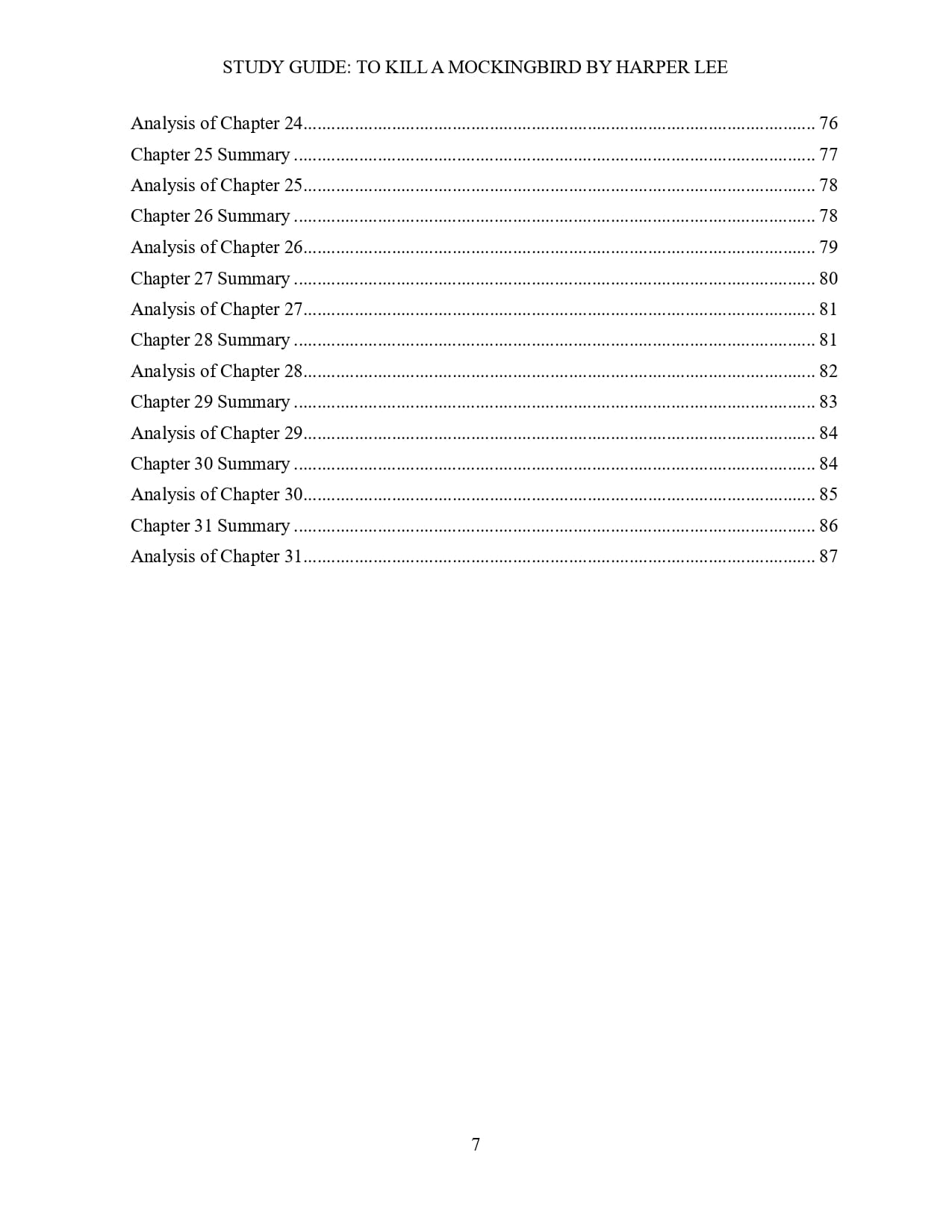
Enjoying this breakdown? What you’re reading is just part of the full experience. The premium PDF edition brings everything together in one seamless, distraction-free document that has the background, setting, plot summary, chapter-to-chapter summary and analysis, narrative devices, characters, and themes. If you’re studying seriously, this is the version you’ll want.


Analysis of Chapter 2
A major theme introduced in this chapter is the contrast between rigid, institutionalised education and natural, organic learning. Miss Caroline represents new, progressive educational theories (which Jem hilariously misidentifies as the “Dewey Decimal System”). However, Harper Lee satirises this approach. The system demands uniformity, to the point that Miss Caroline views Scout’s advanced literacy as a “damage” that must be undone rather than a gift to be nurtured. Scout’s true education has come from her community, her father’s lap, and Calpurnia’s kitchen table. This highlights the novel’s stance that the most valuable lessons are learned outside the classroom.
Chapter 2 of To Kill a Mockingbird masterfully establishes the complex socio-economic ladder of Maycomb County during the Great Depression. Through the Cunningham family, Lee introduces the rural, white farming class. They are devastatingly poor—Walter has hookworms from not wearing shoes—but they are defined by a fierce, honourable pride. Atticus’s explanation to Scout that professional people are poor because the farmers are poor illustrates the interconnected economic struggles of the town. The Cunninghams represent a “set breed of men” who will go hungry to keep their land and maintain their independence.
Miss Caroline functions as a foil to the deeply entrenched customs of Maycomb. Coming from North Alabama, she is an outsider who completely misreads her environment. She reads a fanciful story about cats to children who have “chopped cotton and fed hogs from the time they were able to walk,” and she attempts to impose an urban charity onto a fiercely proud rural boy. Her struggles highlight how insular Maycomb is; the town operates on a complex web of unspoken rules and family histories that everyone is simply expected to know.
We see Scout’s precocious intelligence and her profound innocence. She fundamentally does not understand why she is being punished for knowing how to read and write, nor why her attempt to be helpful regarding Walter Cunningham is viewed as bad behaviour.
Jem’s instructions to Scout on the way to school mark the beginning of his coming-of-age. He is desperately trying to establish his own identity separate from his younger sister. This signals the start of the growing distance between them as they mature.
Chapter 3 Summary of To Kill a Mockingbird
Chapter 3 of To Kill a Mockingbird begins with Scout exacting revenge on Walter Cunningham by rubbing his nose in the dirt in the schoolyard, blaming him for her getting off on the wrong foot with Miss Caroline. Jem intervenes, stops the fight, and surprisingly invites Walter to come home with them for dinner. After some hesitation, Walter agrees, and by the time they reach the Finch house, Jem has made him feel comfortable enough to forget he is a Cunningham.
At the dinner table, Atticus and Walter discuss farm problems like two grown men, leaving Scout and Jem in wonder. The peace is broken when Walter asks for molasses and proceeds to drown his meat and vegetables in it. When Scout rudely questions what he is doing, Walter is humiliated, and Calpurnia summons Scout to the kitchen. Calpurnia furiously reprimands Scout for her bad manners, delivering a stern lecture that anyone who sets foot in the house is “company” and should not be contradicted, regardless of their social standing. Scout is forced to eat the rest of her dinner in the kitchen and unsuccessfully tries to convince Atticus to fire Calpurnia.
When Scout returns to school, she finds her class in an uproar because Miss Caroline is terrified by a “cootie” (louse) crawling out of a student’s hair. A boy named Little Chuck Little, who is poor but a “born gentleman,” steps up to protect and comfort the teacher. The infected boy is Burris Ewell, who is described as the “filthiest human” Scout had ever seen.
Miss Caroline tells Burris to go home and wash his hair with lye soap, but Burris rudely informs her that he was on the verge of leaving anyway, as he has “done done my time for this year.” A student explains to the teacher that the Ewell children only come to school on the first day to satisfy the truant officer and then never return. Before leaving, Burris turns incredibly aggressive, calling Miss Caroline a “snot-nosed slut” and making her cry before he stalks off.
That evening, Scout is deeply discouraged by her experiences and begs Atticus not to send her back to school. She complains about Miss Caroline telling her she can’t read anymore. Atticus uses this moment to teach Scout one of the most important lessons of her life: “You never really understand a person until you consider things from his point of view… until you climb into his skin and walk around in it.” He explains that if Scout learns this simple trick, she will get along much better with all kinds of people, and points out that Miss Caroline made an honest mistake because she couldn’t be expected to learn all of Maycomb’s ways in one day.
Scout tries to argue that she shouldn’t have to go to school because Burris Ewell gets to stay home. Atticus explains that the Ewells are the “disgrace of Maycomb” and live like animals; therefore, the town’s common folk turn a blind eye to their illegal activities, such as truancy and hunting out of season, because forcing them to conform would only hurt the Ewell children. To resolve Scout’s anxiety, Atticus proposes a compromise: if she concedes the necessity of going to school, they will continue reading together every night just as they always have. Scout happily agrees.
Analysis of Chapter 3
This chapter of To Kill a Mockingbird sharply contrasts two of Maycomb’s poorest families: the Cunninghams and the Ewells. Walter Cunningham is dressed in neatly mended overalls, and though his family is destitute, they have pride and integrity. Burris Ewell, by contrast, is filthy, belligerent, and his family is considered the “disgrace of Maycomb for three generations.” The Ewells are presented as a parasitic element of the town, relying on relief checks and showing no desire to improve themselves. This establishes the Ewells as the absolute bottom of Maycomb’s white social ladder, foreshadowing the antagonist role Bob Ewell will play later in the novel.
Atticus’s advice to Scout to “climb into [a person’s] skin and walk around in it” is the moral compass of the entire novel. It establishes Atticus as a paragon of reason and compassion. This philosophy is immediately applied to Miss Caroline, asking Scout to forgive the teacher’s rigid, textbook approach to education by understanding her position as an outsider. This theme of empathy will be heavily tested throughout the book as the town faces the Tom Robinson trial.
Chapter 3 highlights the disconnect between institutionalised education and moral education. Miss Caroline’s classroom is chaotic and rigid; it fails to accommodate the realities of Maycomb’s children. Conversely, the true education of the chapter happens at home. Calpurnia teaches Scout a vital lesson in basic human decency, equality, and hospitality when she defends Walter Cunningham. Atticus then teaches her about compromise, the rigidness of the law, and the necessity of perspective.
Just as Boo Radley represents the misunderstood “other” in the neighbourhood, the Ewells represent an accepted, yet marginalised “other” within the town’s legal and social framework. Atticus explains that the town “judiciously allowed them certain privileges” (like hunting out of season) simply to prevent the Ewell children from starving. This shows that the rigid laws and social codes of Maycomb are actually quite malleable depending on a family’s background and circumstances.
Related:
- Chapter 4 to 6 Summary and Analysis of To Kill a Mockingbird by Harper Lee
- Chapter 7 to 9 Summary and Analysis of To Kill a Mockingbird by Harper Lee
- Chapter 10 to 12 Summary and Analysis of To Kill a Mockingbird by Harper Lee
- Chapter 13 to 15 Summary and Analysis of To Kill a Mockingbird by Harper Lee
- Chapter 16 to 21 Summary and Analysis of To Kill a Mockingbird by Harper Lee
- Chapter 22 to 24 Summary and Analysis of To Kill a Mockingbird by Harper Lee
- Chapter 25 to 28 Summary and Analysis of To Kill a Mockingbird by Harper Lee
- Chapter 29 to 31 Summary and Analysis of To Kill a Mockingbird by Harper Lee
Receive Literary Updates through our Social Media Channels:
- WhatsApp: Literature PADI or Literature-in-English with LP
- Telegram: Literature PADI
- YouTube: @literaturepadi
- Facebook: Literature PADI


