

Download our SSCE Study Guide Bundle
Chapter 7 Summary of To Kill a Mockingbird
Chapter 7 of To Kill a Mockingbird begins with Scout starting the second grade, which she finds just as grim and restrictive as the first. The only consolation is that she now stays at school as late as Jem, which allows them to walk home together. One afternoon, Jem finally breaks his week-long moody silence and reveals what actually happened the night he went back to the Radley place to retrieve his pants. He tells Scout that when he found them, they were not tangled in the wire where he had left them; instead, they were folded neatly across the fence “like they were expectin’ me,” and had been crudely sewn up, as if by someone reading his mind.
As autumn progresses, the children begin to find more items left in the knot-hole of the Radley oak tree. First, they find a ball of grey twine. Later in October, they discover two miniature figures expertly carved in soap; to their astonishment, the figures are exact replicas of Jem and Scout. This is followed by a whole pack of chewing gum, a tarnished spelling medal from an old Maycomb County contest, and their biggest prize: a broken pocket watch on a chain with an aluminium knife.
Realising these items are deliberately being left for them, Jem and Scout decide to write a formal thank-you letter to their anonymous benefactor. However, when Jem runs to the tree the next morning to deliver the note, he turns stark white: the knot-hole has been completely filled with cement.
Jem waits for Mr. Nathan Radley to walk by and asks him if he put the cement in the tree. Mr. Nathan admits that he did, claiming that the tree was dying and that “you plug ’em with cement when they’re sick.” Suspicious, Jem asks Atticus to look at the tree that evening. Atticus examines the leaves and the trunk but confirms that the tree is perfectly healthy. When Jem points out that Mr. Nathan said it was dying, Atticus gently suggests that Mr. Radley likely knows more about his own trees than they do. Jem stands alone on the front porch until long after nightfall; when he finally comes inside, Scout sees that his face is dirty with the streaks of silent tears.
Analysis of Chapter 7
Chapter 7 of To Kill a Mockingbird is a profound milestone in Jem’s coming-of-age. When he discovers his pants folded and sewn, he begins to realise that Boo Radley is not a monster, but a watchful, protective, and lonely human being. At the end of the chapter, Jem’s tears on the porch are not merely because he lost a source of free gifts; he is crying because he now fully understands the tragic reality of Boo’s existence. He recognises that Nathan Radley filled the hole to cruelly cut off his brother’s only tentative connection to the outside world. Jem’s silent weeping marks a shift from childhood self-absorption to deep, painful empathy for the suffering of another.
The knot-hole is positioned as Boo Radley’s only voice. The escalation of the gifts shows Boo’s growing affection for the children. The carved soap dolls are particularly significant; they prove that Boo has been observing Jem and Scout closely and affectionately. The gift of the broken pocket watch goes to show that Boo is offering them his most prized possessions. Because Boo is physically silenced and imprisoned, these objects are his only method of speaking to the outside world.
Nathan Radley’s act of cementing the tree mirrors his father’s original act of imprisoning Boo inside the house. Nathan fills the knot-hole to deliberately sever the fragile bond Boo has managed to form with the children. When Atticus inadvertently exposes Nathan’s lie about the tree dying, it highlights the senselessness of Nathan’s cruelty. The cement is a physical manifestation of the psychological walls the Radley family has built around Boo.
The Gothic, terrifying caricature of Boo Radley from the earlier chapters is completely dismantled here. The person who folded Jem’s pants and carved soap dolls of the children is gentle and observant. Jem’s realisation of this truth shifts the tone of the children’s relationship with Boo from one of morbid curiosity and fear to one of quiet, tragic understanding.
Get the Full Analysis in PDF
Enjoying this breakdown? What you’re reading is just part of the full experience. The premium PDF edition brings everything together in one seamless, distraction-free document that has the background, setting, plot summary, chapter-to-chapter summary and analysis, narrative devices, characters, and themes. If you’re studying seriously, this is the version you’ll want.


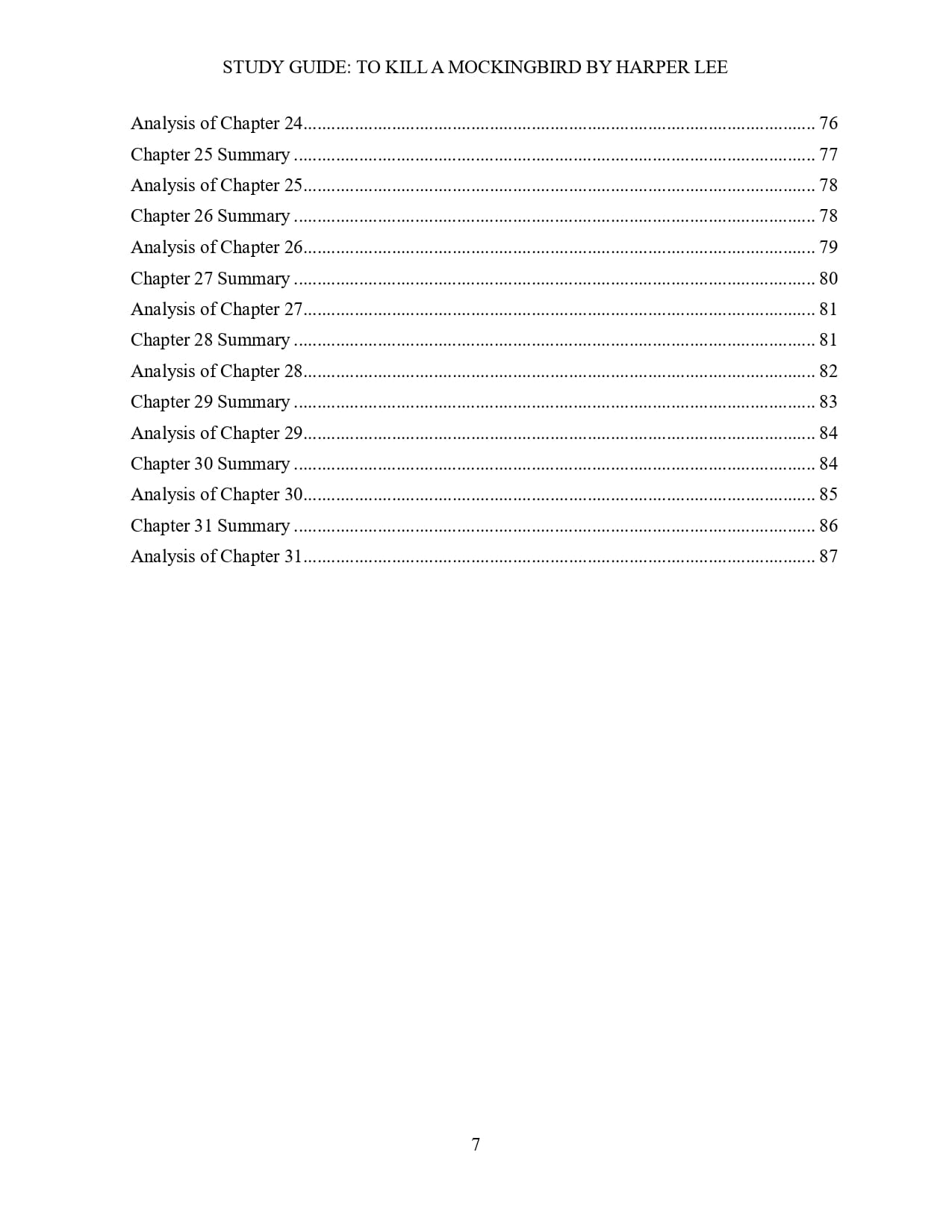
Chapter 8 Summary of To Kill a Mockingbird
Chapter 8 of To Kill a Mockingbird begins with Maycomb experiencing an unusually harsh winter, its coldest since 1885. Mr. Avery blames the extreme weather on bad children who disobey their parents. This fabricated lie causes Jem and Scout to feel a burden of guilt. Old Mrs. Radley dies during this time, but her passing causes hardly a ripple in the neighbourhood, and the children are slightly disappointed to learn she died of natural causes rather than at the hands of Boo.
When it miraculously begins to snow, school is cancelled. Having never seen snow before, Jem and Scout are ecstatic. Because there is barely enough snow to gather, Jem comes up with an ingenious plan to build a snowman: he constructs a torso out of mud and dirt from the backyard, then plasters the outside with the snow they transferred from Miss Maudie’s yard. Jem shapes the figure to look exactly like their grumpy neighbour, Mr. Avery, complete with his large stomach. When Atticus comes home, he is impressed by Jem’s ingenuity but gently orders him to disguise the caricature so Mr. Avery won’t be offended. Jem compromises by placing Miss Maudie’s sunhat and hedge-clippers on the figure.
In the middle of the freezing night, Atticus wakes the children and ushers them outside. Miss Maudie’s house has caught fire. Atticus tells Jem and Scout to stand safely out of the way in front of the Radley gate and not to move.
The children watch as the men of Maycomb, in varying states of undress, desperately try to save Miss Maudie’s furniture. Mr. Avery gets trapped on the second-floor porch while pushing a mattress out the window, but he narrowly escapes before the house collapses. The town’s old fire truck is broken down by the cold, but eventually, trucks from neighbouring towns arrive. Unfortunately, Miss Maudie’s house burns to the ground regardless.
When the children return inside, Atticus makes them hot chocolate and sternly asks Scout where she got the brown woollen blanket wrapped around her shoulders. Both Scout and Jem are bewildered. Both insist they never moved from the Radley gate.
Suddenly realising what happened, Jem loses his mind with excitement and spills all of their closely guarded secrets to Atticus—the knot-hole, his mended pants, and how Mr. Nathan filled the tree with cement—frantically trying to prove that Boo Radley is not a dangerous monster. Atticus gently explains that they shouldn’t let the discovery inspire them to further glory. He reveals that Boo Radley himself had sneaked up in the dark and put the blanket over Scout while she was distracted by the fire. Scout is so shocked by the thought of being so close to Boo that her stomach turns to water.
The next morning, the children visit Miss Maudie, expecting her to be devastated. Instead, she is entirely unbothered as she cheerfully explains that she hated her “old cow barn” of a house anyway. She looks forward to building a smaller house to have more room for her beloved azaleas.
Analysis of Chapter 8
This chapter of To Kill a Mockingbird is a massive turning point for the motif of Boo Radley. The blanket incident definitively proves that Boo is not the “malevolent phantom” of neighbourhood gossip, but rather a gentle, protective, and observant figure. While the rest of the town is focused on the fire, Boo is focused on the children. He slips out of his forced isolation to keep Scout warm. Jem’s realisation of this fact marks a significant leap in his maturity; he immediately defends Boo to Atticus, as he realises that Boo is a victim, not a monster.
Jem’s “mudman” turned snowman carries heavy symbolic weight in the context of the novel’s racial themes. Because there is not enough pure white snow, Jem must use dark earth for the foundation, and he only masks it with a thin layer of white. When Scout points out that she has never heard of a “nigger snowman,” Jem replies, “He won’t be black long.” This construction symbolises that beneath the surface (and beneath skin colour), humans are made of the same substance. It also mirrors the racial dynamics of Maycomb. It hints at how the town’s white exterior is entirely dependent on the marginalised Black population beneath it. Interestingly, the fire later melts the snow, and leaves only the black mud behind.
Besides, the fire is depicted in this chapter as a microcosm of Maycomb’s social fabric. In a moment of genuine crisis, the town’s strict social hierarchies and deep-seated prejudices briefly dissolve. Men of all classes work together to save Miss Maudie’s belongings. In this regard, they are seen pushing a broken fire truck and risking their lives. This accurately captures Maycomb in a different light. Beyond its depiction as a town deeply infected by racism, it is also a tight-knit community that supports its own in troubled times.
Additionally, Miss Maudie’s reaction to the loss of her home strengthens her position as the novel’s primary female moral compass. While others might be crushed by the loss of everything they own, she remains cheerful and forward-looking. Her lack of materialism contrasts sharply with the petty, status-obsessed attitudes of other Maycomb ladies (like Aunt Alexandra or Miss Stephanie). Her resilience teaches the children an important lesson about maintaining perspective and dignity in the face of disaster.
Chapter 9 Summary of To Kill a Mockingbird
Chapter 9 of To Kill a Mockingbird begins with Scout nearly getting into a fight with a schoolmate, Cecil Jacobs, because he announces to the schoolyard that “Scout Finch’s daddy defended niggers.” When Scout asks Atticus about it, he tells her not to use the word “nigger” because it is “common” and confirms that he is indeed defending a Black man named Tom Robinson. Atticus explains that if he did not defend this man, he could not hold up his head in town, represent the county in the legislature, or even tell his children what to do.
Atticus acknowledges that they are not going to win the case, but teaches Scout a profound lesson: “Simply because we were licked a hundred years before we started is no reason for us not to try to win.” He asks Scout to keep her fists down and fight with her head for a change. Taking his words to heart, Scout walks away from a fight with Cecil the next day. In fact, she feels extremely noble doing so.
Christmas arrives. This is the seasonal period when Atticus’s brother, Uncle Jack, chooses to come to Maycomb. Uncle Jack is a doctor who treats the children with respect but knows when to reprimand them for bad behaviour. This is particularly true when he reprimands Scout for her newly acquired habit of swearing; he warns her she will get into trouble if she continues. Atticus gives the children the air rifles they asked for, and the family heads to Finch’s Landing to spend the holiday with Aunt Alexandra, her taciturn husband Uncle Jimmy, and their remarkably boring grandson, Francis.
At Finch’s Landing, Aunt Alexandra heavily criticises Scout’s tomboyish attire. She insists that Scout cannot be a lady if she wears breeches. To imprint Scout’s feminine identity, Aunt Alexandra tells her she should be playing with tea sets and wearing the pearl necklace she was given at birth. She believes Scout should be a “ray of sunshine” in Atticus’s life, a sentiment that sets Scout’s teeth on edge.
While the adults rest, Scout is forced to entertain Francis, who proudly repeats Aunt Alexandra’s harsh gossiping. Francis claims that Atticus is ruining the family by letting his children run wild and by being a “nigger-lover.” Infuriated by the insult, Scout chases Francis into the kitchen and punches him. She splits her knuckle to the bone on his front teeth in the process.
Uncle Jack restrains Scout and spanks her without asking for her side of the story. Upon returning home, a deeply hurt Scout avoids Uncle Jack until he comes to her room. She points out that he was unfair because he “never stopped to gimme a chance to tell you my side of it,” unlike Atticus, who always listens to both sides. When Scout reveals what Francis said about Atticus, Uncle Jack is furious, but Scout makes him promise not to tell Atticus, as she had promised her father she wouldn’t let the town’s comments make her lose her temper.
Later that night, Scout sneaks out for a drink of water and eavesdrops on a conversation between Atticus and Uncle Jack. Atticus tells Jack that “children are children, but they can spot an evasion quicker than adults.” He advises his brother to always answer a child truthfully rather than make up stories.
The conversation shifts to the upcoming Tom Robinson trial. Atticus explains that the case will be incredibly difficult because it boils down to a Black man’s word against the Ewell family’s word, and the jury cannot be expected to believe Tom Robinson. Atticus expresses his deepest fear: he hopes he can get Jem and Scout through the trial without them catching “Maycomb’s usual disease.” This disease, according to him, is the tendency of reasonable people to go “stark raving mad when anything involving a Negro comes up.” Atticus suddenly tells Scout to go to bed; years later, she realises her father knew she was listening the entire time and purposefully wanted her to hear every word he said.
Analysis of Chapter 9
Chapter 9 marks a definitive turning point in To Kill a Mockingbird. The narrative shifts its focus from the childhood superstitions surrounding Boo Radley to the harsh, real-world adult issues of racism, prejudice, and the impending Tom Robinson trial. The town’s underlying bigotry begins to actively encroach on the children’s lives through the taunts of their peers and relatives.
Atticus establishes the novel’s core definition of true courage. He knows that the deeply entrenched racism of the South means he will lose the case (“we were licked a hundred years before we started”). However, his personal conscience and moral integrity compel him to do the right thing regardless of the outcome. He cannot act as a moral authority to his children if he fails to stand up for what is right.
Atticus coins the term “Maycomb’s usual disease” to describe the mindless, irrational prejudice that infects the town. Lee demonstrates how deeply rooted this disease is by showing it in the mouths of children. For example, Cecil Jacobs and Francis Hancock merely parrot the racist vitriol they hear from their parents and grandparents. This goes to prove the point that racism is taught, not innate.
Through Aunt Alexandra, Harper Lee critiques the rigid, oppressive gender roles of the 1930s South. Aunt Alexandra is “fanatical” on the subject of Scout’s attire. She sees her overalls as an offence against her breeding and her duty to become a Southern belle. Scout’s resistance to these expectations highlights her desire for freedom and her rejection of superficial societal rules.
Moreover, the chapter contrasts Atticus’s parenting style with the more traditional methods of his siblings. While Aunt Alexandra relies on strict behavioural codes and Uncle Jack relies on quick physical punishment and tall tales (like his story about Lord Melbourne to avoid explaining a bad word), Atticus insists on fairness, listening to both sides, and above all, telling children the absolute truth. Atticus’s decision to let Scout overhear his fears about the trial shows his profound respect for her intelligence and his desire to emotionally prepare her for the town’s coming backlash.
Related:
- Chapter 1 to 3 Summary and Analysis of To Kill a Mockingbird by Harper Lee
- Chapter 4 to 6 Summary and Analysis of To Kill a Mockingbird by Harper Lee
- Chapter 10 to 12 Summary and Analysis of To Kill a Mockingbird by Harper Lee
- Chapter 13 to 15 Summary and Analysis of To Kill a Mockingbird by Harper Lee
- Chapter 16 to 21 Summary and Analysis of To Kill a Mockingbird by Harper Lee
- Chapter 22 to 24 Summary and Analysis of To Kill a Mockingbird by Harper Lee
- Chapter 25 to 28 Summary and Analysis of To Kill a Mockingbird by Harper Lee
- Chapter 29 to 31 Summary and Analysis of To Kill a Mockingbird by Harper Lee
Receive Literary Updates through our Social Media Channels:
- WhatsApp: Literature PADI or Literature-in-English with LP
- Telegram: Literature PADI
- YouTube: @literaturepadi
- Facebook: Literature PADI


