

Download our SSCE Study Guide Bundle
Chapter 4 Summary of To Kill a Mockingbird
Chapter 4 of To Kill a Mockingbird begins with Scout summarising her frustrating first year of school. She notes that the “Dewey Decimal System” consists mainly of miles of construction paper and crayons. She feels she is being cheated out of a real education and learns far more at home.
One afternoon, running home past the Radley Place, Scout spots tinfoil winking in the knot-hole of one of the Radley oak trees. She reaches in and finds two unwrapped pieces of Wrigley’s Double-Mint chewing gum, which she quickly crams into her mouth after sniffing it to make sure it isn’t poisoned. When Jem finds out where the gum came from, he furiously orders her to spit it out and gargle.
On the last day of school, as they pass the same tree, Jem spots another piece of tinfoil. Inside the knot-hole is a small velvet ring box containing two polished Indian-head pennies, minted in 1900 and 1906. Jem recognises them as “strong magic” that brings good luck. The children debate what to do with them. They eventually decide to keep them safe in Jem’s trunk until the next school year, assuming they might belong to a rural child who rides the bus.
Summer arrives, and two days later, Dill returns to Maycomb. He boasts of having ridden the train by himself. He also claims his father is the president of the L & N Railroad. The children soon grow bored with their usual plays. Scout offends Jem by contradicting his ghost story about “Hot Steams” (spirits unable to get to heaven who suck people’s breath). To get back at her, Jem pushes Scout inside an old car tire as hard as he can down the sidewalk.
Scout spins out of control, dizzy and nauseated, until the tire violently crashes into a barrier and pops her out. When she clears her head, she realises with terror that she has landed directly in the Radley front yard. Paralysed by fear, she leaves the tire behind. This forces a furious Jem to run into the yard to retrieve it.
Attempting to prove his bravery after the tire incident, Jem announces a new game: they are going to play “Boo Radley.” Over the summer, they weave local gossip into a melancholy, melodramatic play. Scout plays Mrs. Radley, Dill plays old Mr. Radley, and Jem plays Boo, hiding under the steps and occasionally howling. The climax of the play is a scene where Jem sneaks a pair of scissors from Calpurnia’s sewing drawer and fakes plunging them into Dill’s thigh, mimicking the legend of Boo stabbing his father.
One day, Atticus catches them acting out the scissors scene. When he asks if their game has anything to do with the Radleys, Jem lies and says it doesn’t. Atticus confiscates the scissors and leaves them with a stern warning. Jem insists they can keep playing because Atticus didn’t explicitly forbid it, but Scout wants to quit. She has two reasons: first, Atticus’s arrival; second, a secret she kept to herself. On the day she crashed into the Radley yard in the tire, she heard a sound from inside the house—someone was laughing.
Analysis of Chapter 4
Harper Lee continues to satirise the institutional education system of the 1930s. Scout notes that her first year of school was an “endless Project that slowly evolved into a Unit,” leaving her feeling cheated. Scout’s natural intelligence is stifled by the school’s rigid “Group Dynamics.” This reinforces the theme that true wisdom and moral education in this novel occur at home and in the community, not in the classroom.
The discovery of the gum and the Indian-head pennies in the Radley oak tree marks a major turning point in the novel. These items represent Boo Radley’s first tentative, silent attempts to communicate with the outside world. The choice of gifts is significant: the pennies have been “scrubbed and polished,” showing care and intentionality. While the town views the Radley place as poisoned and malevolent, the tree provides a stark contrast, yielding tokens of kindness.
The creation of the “Boo Radley” game highlights the duality of childhood innocence and thoughtless cruelty. The children take a genuine human tragedy—a man locked away from the world—and turn it into a Gothic pantomime for their own entertainment. It reflects how children mimic the prejudices and gossip of the adult world. At the same time, Jem’s insistence on playing the game is a psychological mechanism to mask his own fear of the Radley place.
The chapter’s final sentence is one of the most important in the early part of the novel: “Someone inside the house was laughing.” This detail completely shatters the monstrous “malevolent phantom” myth the children have constructed. The laugh suggests that Boo is not a bloodthirsty ghoul, but a lonely, gentle observer who finds genuine amusement in the children’s play. It foreshadows Boo’s true nature and his hidden affection for Scout and Jem.
Chapter 5 Summary of To Kill a Mockingbird
Chapter 5 of To Kill a Mockingbird begins with Scout feeling increasingly alienated as Jem and Dill grow closer; they spend their days plotting in the treehouse and exclude her, threatening to call her a “girl” if she complains. As a result, Scout begins spending her summer twilights sitting on the front porch with their neighbour, Miss Maudie Atkinson.
Miss Maudie is a widow who hates being indoors; she spends her days working in her flower beds wearing men’s coveralls and an old straw hat, but after her five o’clock bath, she reigns over the street in “magisterial beauty.” The children have a tacit treaty with her: they can play in her yard and eat her scuppernongs as long as they don’t ruin her arbours. Miss Maudie treats the children with respect. She cements her friendship with Scout by flashing her gold bridgework and baking them cakes.
During one of their evening conversations, Scout asks Miss Maudie if Boo Radley is still alive. Miss Maudie confirms that he is, referring to him by his real name, Arthur, and explains that the rumours about him being stuffed up the chimney are nonsense. She reveals that old Mr. Radley was a “foot-washing Baptist,” a sect that takes the Bible literally and believes that any form of pleasure is a sin. Miss Maudie shares that some of these foot-washers once told her that she and her flowers were going to hell because she spent too much time outdoors instead of reading the Bible.
Miss Maudie explains that the Radley house is a “sad house” and hints at the psychological damage inflicted on Arthur by his strict father. She notes that “sometimes the Bible in the hand of one man is worse than a whiskey bottle in the hand of—oh, of your father.” With this analogy, Miss Maudie illustrates how religion can be warped to oppress people. When Scout mentions that Atticus doesn’t drink, Miss Maudie clarifies that Atticus is exactly the same in his house as he is on the public streets; that he completely lacks the hypocrisy found in the Radley home.
The next morning, Scout catches Jem and Dill plotting to deliver a note to Boo Radley. Jem attaches the note to a yellow bamboo fishing pole and attempts to push it through a loose shutter on the Radley house, while Dill stands watch with a dinner bell to warn them if anyone approaches. The note politely asks Boo to come out and tell them what he does in there, promising they won’t hurt him and will buy him an ice cream.
The plan goes awry when Atticus suddenly appears, and Dill frantically rings the warning bell directly in Atticus’s face. Atticus confiscates the note and orders the children to “stop tormenting that man.” He delivers a stern lecture, explaining that what Mr. Radley does is his own business, that he has a right to privacy, and that the children’s “asinine game” is incredibly disrespectful. Atticus then uses a clever cross-examination trick to get Jem to accidentally admit that they were “putting his life’s history on display for the edification of the neighbourhood.” Realising he has been outsmarted by his father’s lawyerly tactics, Jem yells after Atticus that he isn’t so sure he wants to be a lawyer anymore.
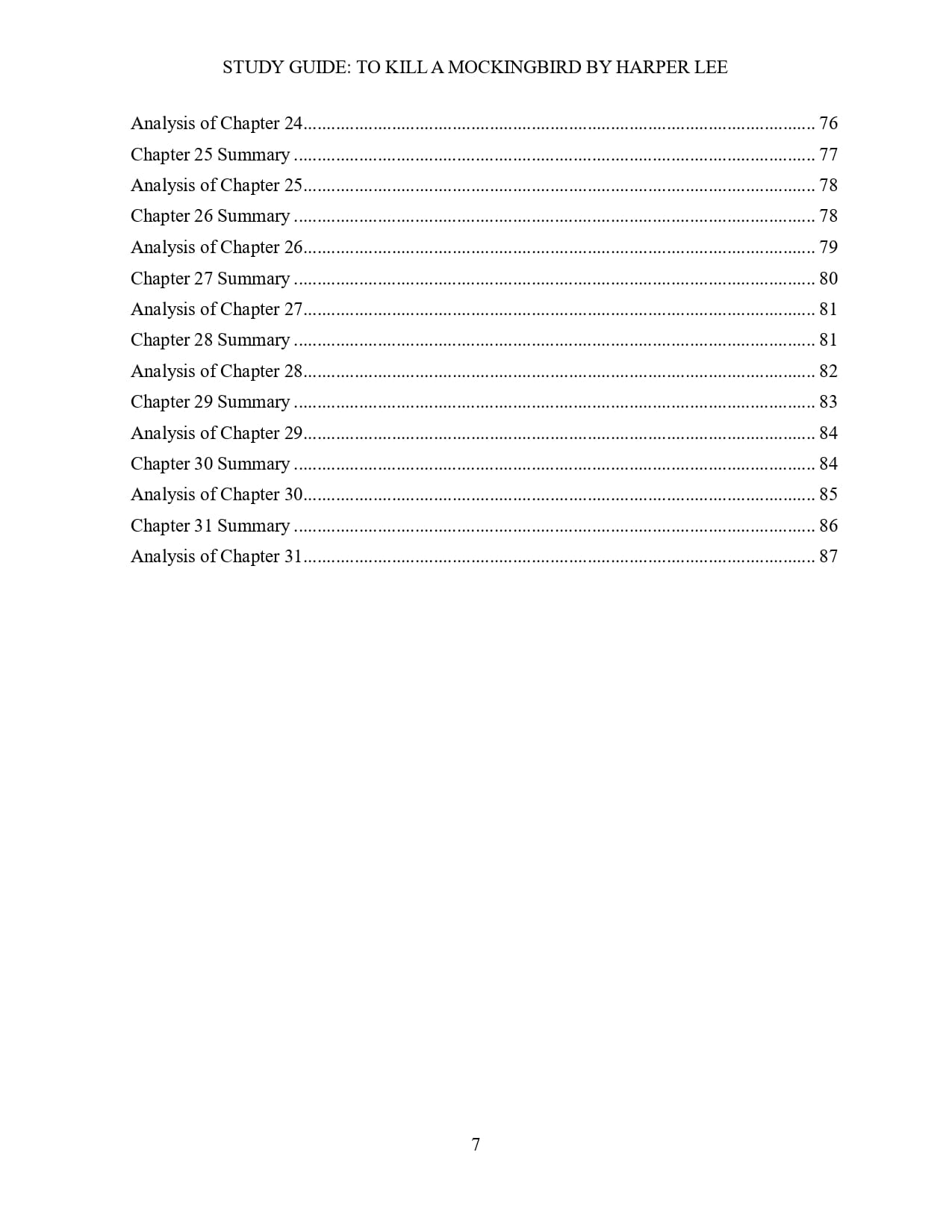
Get the Full Analysis in PDF
Enjoying this breakdown? What you’re reading is just part of the full experience. The premium PDF edition brings everything together in one seamless, distraction-free document that has the background, setting, plot summary, chapter-to-chapter summary and analysis, narrative devices, characters, and themes. If you’re studying seriously, this is the version you’ll want.


Analysis of Chapter 5
Miss Maudie Atkinson is introduced as a crucial mentor for Scout. Unlike the gossipy Miss Stephanie Crawford or the rigidly traditional Aunt Alexandra (who appears later in the novel), Miss Maudie is deeply respectful of the children. She functions as a female counterpart to Atticus in that she echoes his moral philosophies. Her assertion that Atticus is “the same in his house as he is on the public streets” reinforces his integrity and establishes him as the moral centre of Maycomb.
A major theme in this chapter of To Kill a Mockingbird is the danger of religious extremism and hypocrisy. Through Miss Maudie, Lee contrasts the joyful, natural world (represented by Maudie’s beloved garden) with the oppressive, rigid doctrine of the “foot-washing Baptists.” Miss Maudie’s profound metaphor—that the Bible in a fanatic’s hand is worse than whiskey in a good man’s hand—highlights how religion can be weaponised to destroy people’s lives. It specifically points to the psychological imprisonment of Arthur Radley.
Chapter 5 shifts the narrative regarding Boo Radley. Up until now, Boo has been a Gothic caricature—a ghost or a monster created by neighbourhood gossip. Miss Maudie begins dismantling this myth by insisting on calling him by his real name, Arthur, and recalling that he always spoke nicely to her when he was a boy. This humanises him and transforms him from a figure of horror into a tragic victim of a “sad house” and a domineering father.
Atticus’s intervention at the end of the chapter brings his core philosophy of empathy to the forefront. He teaches the children that Arthur Radley is a human being deserving of basic civil rights and privacy. By telling the children that they should use the front door instead of a side window if they want to communicate, Atticus criticises their treatment of Boo as a circus freak or an exotic exhibit. This continues to build the novel’s overarching lesson about viewing the world from other people’s perspectives.
Chapter 6 Summary of To Kill a Mockingbird
On Dill’s last night in Maycomb before returning to Meridian, he and Jem ask Atticus for permission to sit by Miss Rachel’s fishpool. However, the boys have a secret plan: they intend to peek into the window of the Radley house with the loose shutter to finally get a look at Boo Radley. Scout is terrified and protests, but Jem coerces her into coming by declaring that she is getting “more like a girl every day.”
Under the cover of darkness, the three children sneak under the wire fence at the back of the Radley lot and creep through the collard patch. Jem and Scout hoist Dill up to look through the window, but he only sees curtains and a small, distant light.
Jem decides to try the back window. As he steps onto the back porch and peers in, Scout sees the crisp shadow of a man wearing a hat cross the porch towards Jem. The shadow stops, drops its arm, and then moves back off the porch. The children freeze in terror before frantically fleeing. As they run through the collard patch, the roar of a shotgun shatters the neighbourhood’s silence.
In their desperate escape, Jem gets his pants tangled in the wire fence. To get loose and avoid being caught, he is forced to kick his pants off and run the rest of the way in his shorts.
The children casually walk to the front of the Radley Place, where a crowd of neighbours, including Atticus, has gathered. Mr. Nathan Radley is standing with a shotgun, and Miss Stephanie Crawford informs the children that he shot at a “Negro” in his collard patch.
When Atticus asks Jem where his pants are, Dill quickly invents a lie to save them: he claims he won Jem’s pants while playing “strip poker” by the fishpool. When the neighbours react with shock to the idea of gambling, Jem quickly amends the story, stating they were only playing with matches, not cards. Atticus accepts this but strictly forbids any future poker playing and tells Jem to go retrieve his pants from Dill.
Later that night, Jem decides he must return to the Radley yard to get his pants back. Scout begs him not to go, fearing Mr. Nathan will shoot him, but Jem explains his reasoning: Atticus has never whipped him, and Jem wants to keep it that way. Jem sneaks out in the middle of the night, successfully recovers his pants, and returns to his cot, trembling in the dark.
Analysis of Chapter 6
Chapter 6 of To Kill a Mockingbird marks a critical turning point in Jem’s maturation and his relationship with Scout, who notes that it was at this moment that they “first began to part company.” Jem’s decision to risk his life to retrieve his pants is not driven by the fear of physical punishment, but by a deep desire to maintain his father’s respect. He realises that lying and losing Atticus’s trust would be a far worse consequence than a whipping. This demonstrates Jem’s developing internal moral compass and his growing alignment with Atticus’s values of honour and integrity.
The neighbourhood’s reaction to the gunshot serves as a microcosm of Maycomb’s deep-seated racial prejudice. When a prowler is heard in the yard, Mr. Nathan Radley and the rest of the community immediately, and without evidence, assume the culprit is a “Negro.” Miss Stephanie Crawford eagerly spreads the rumour, adding that Mr. Nathan has the other barrel waiting for the next sound he hears, “be it dog, nigger, or—Jem Finch!” This casual grouping of a Black person with a stray animal highlights the dehumanisation prevalent in the town. It foreshadows the inevitable, biased assumption of Tom Robinson’s guilt later in the novel.
Up until this point, the children’s obsession with the Radley Place has been treated like a Gothic fairy tale or a summer game. However, the appearance of the very real, physical shadow and the blast of the shotgun thrust the children out of their imaginative play and into actual, life-threatening danger. The “malevolent phantom” of their games is replaced by a real man with a gun. This serves as a harsh wake-up call to the genuine perils of the adult world.
Harper Lee continues to explore the constraints of gender through Scout’s perspective. Jem successfully manipulates Scout into joining the dangerous raid by accusing her of acting “more like a girl every day.” For Scout, being associated with femininity is an insult synonymous with cowardice and exclusion. This incident highlights the immense pressure she feels to conform to the masculine bravery modelled by Jem and Dill. It places her in direct conflict with the Southern belle expectations that will later be pushed upon her by Aunt Alexandra.
Related:
- Chapter 1 to 3 Summary and Analysis of To Kill a Mockingbird by Harper Lee
- Chapter 7 to 9 Summary and Analysis of To Kill a Mockingbird by Harper Lee
- Chapter 10 to 12 Summary and Analysis of To Kill a Mockingbird by Harper Lee
- Chapter 13 to 15 Summary and Analysis of To Kill a Mockingbird by Harper Lee
- Chapter 16 to 21 Summary and Analysis of To Kill a Mockingbird by Harper Lee
- Chapter 22 to 24 Summary and Analysis of To Kill a Mockingbird by Harper Lee
- Chapter 25 to 28 Summary and Analysis of To Kill a Mockingbird by Harper Lee
- Chapter 29 to 31 Summary and Analysis of To Kill a Mockingbird by Harper Lee
Receive Literary Updates through our Social Media Channels:
- WhatsApp: Literature PADI or Literature-in-English with LP
- Telegram: Literature PADI
- YouTube: @literaturepadi
- Facebook: Literature PADI


