

Download our SSCE Study Guide Bundle
Act 4, Scene 9 Summary of Antony and Cleopatra
Act 4, Scene 9 of Antony and Cleopatra takes place at night in Octavius Caesar’s camp. It is a quiet, sombre scene that brings the tragic arc of Domitius Enobarbus to its conclusion. The scene opens with sentinels standing at their posts in Caesar’s camp. They note that the night is “shiny” (clear). They discuss the impending battle, which is expected to begin by the second hour of the morning.
Domitius Enobarbus enters, unaware of the guards, who stand back to listen to him. Overcome with unbearable guilt for abandoning Antony, Enobarbus calls upon the “blessed moon” to bear witness to his repentance. Addressing the moon as the “sovereign mistress of true melancholy,” he prays for the “poisonous damp of night” to fall upon him and end his life, which has become a “rebel” to his will.
In his final agonising moments, he imagines throwing his heart against the “flint and hardness” of his fault so that it will dry with grief and “break to powder.” He cries out to his former commander; he declares that Antony is “nobler than my revolt is infamous.” He pleads for Antony’s forgiveness. Simultaneously, he asks the world to forever remember him as a “master-leaver and a fugitive.” Afterwards, Enobarbus cries out Antony’s name twice and falls to the ground, dead.
The sentinels approach him and realise that the “hand of death” has taken him. Hearing the distant drums beginning to “wake the sleepers” for the morning’s battle, they decide to carry his body back to the “court of guard.” They recognise him as a man of note and hold out a faint hope that he might yet recover.
Get the Full Analysis in PDF
Enjoying this breakdown? What you’re reading is just part of the full experience. The premium PDF edition brings everything together in one seamless, distraction-free document that has the background, setting, plot summary, act-to-act summary and analysis, dramatic devices, characters, and themes. If you’re studying seriously, this is the version you’ll want.


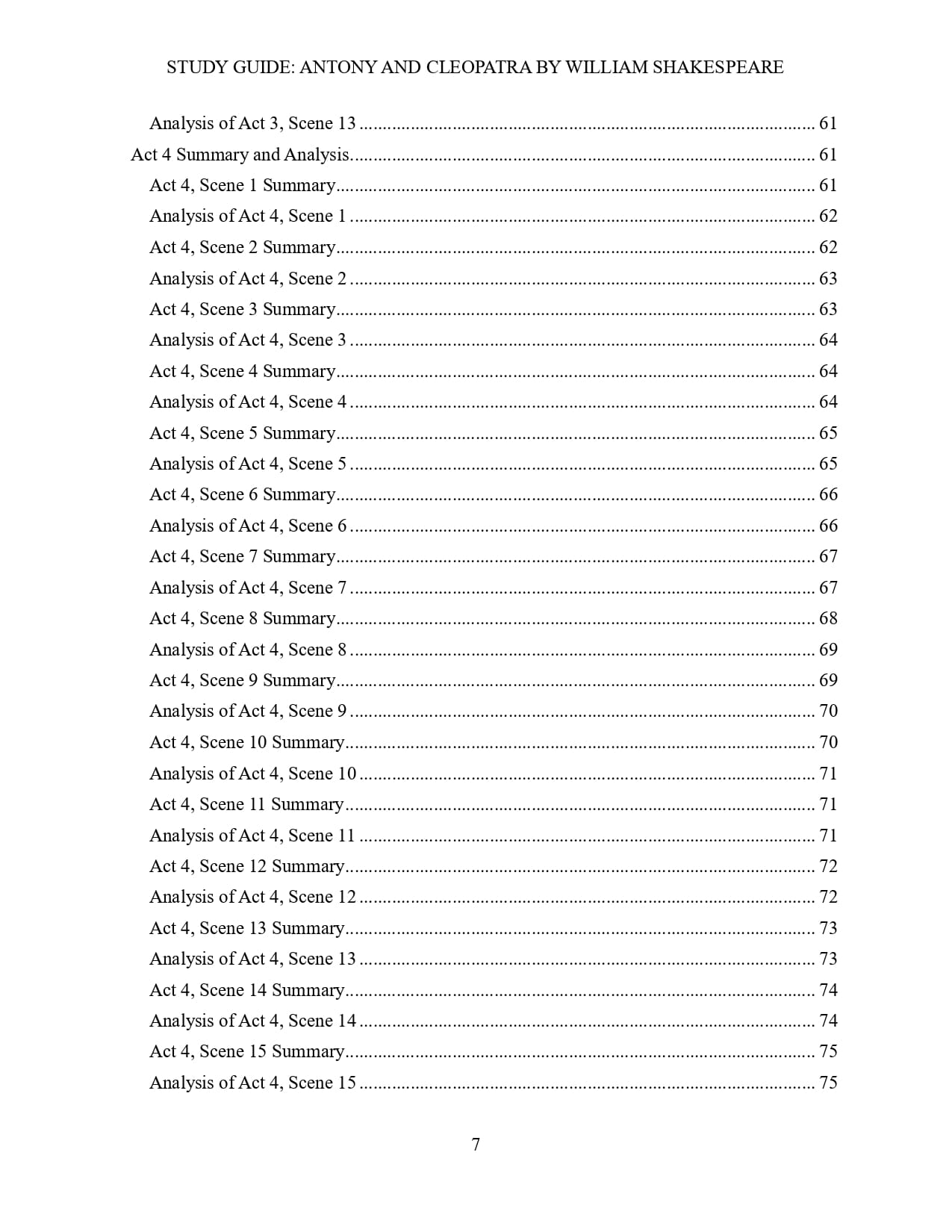
Analysis of Act 4, Scene 9
Enobarbus does not die in battle or by execution; he essentially wills himself to die of a broken heart. His desperate plea for his heart to “break to powder” against the flint of his betrayal shows that Antony’s immense generosity (sending Enobarbus his treasure in Scene 5) was a fatal psychological blow. Antony’s grace weaponised Enobarbus’s own conscience against him.
Up till now, Enobarbus has served as the cynical voice of reason and military pragmatism. He abandoned Antony because rational logic dictated that staying with a doomed, emotionally compromised leader was foolish. However, this scene proves that in Shakespeare’s Rome, pure logic is insufficient. Enobarbus’s rational choice destroys his soul. His final realisation that Antony is “nobler than my revolt is infamous” cements Antony’s tragic, almost god-like stature. Though Caesar is winning the geopolitical war, Antony has won the moral and emotional victory over his greatest soldier’s heart.
Finally, the quiet, melancholic atmosphere of the moonlit watch sharply contrasts with the loud, brassy celebrations of Antony’s camp in the previous scene. The distant beating of the drums at the scene’s end serves as an ominous ticking clock; it signals that the brief night of rest and reflection is over, and the final, decisive day of the war has arrived.
Related:
- Act 4, Scene 1 Summary and Analysis of Antony and Cleopatra
- Act 4, Scene 2 Summary and Analysis of Antony and Cleopatra
- Act 4, Scene 3 Summary and Analysis of Antony and Cleopatra
- Act 4, Scene 4 Summary and Analysis of Antony and Cleopatra
- Act 4, Scene 5 Summary and Analysis of Antony and Cleopatra
- Act 4, Scene 6 Summary and Analysis of Antony and Cleopatra
- Act 4, Scene 7 Summary and Analysis of Antony and Cleopatra
- Act 4, Scene 8 Summary and Analysis of Antony and Cleopatra
- Act 4, Scene 10 Summary and Analysis of Antony and Cleopatra
- Act 4, Scene 11 Summary and Analysis of Antony and Cleopatra
- Act 4, Scene 12 Summary and Analysis of Antony and Cleopatra
- Act 4, Scene 13 Summary and Analysis of Antony and Cleopatra
- Act 4, Scene 14 Summary and Analysis of Antony and Cleopatra
- Act 4, Scene 15 Summary and Analysis of Antony and Cleopatra
Receive Literary Updates through our Social Media Channels:
- WhatsApp: Literature PADI or Literature-in-English with LP
- Telegram: Literature PADI
- YouTube: @literaturepadi
- Facebook: Literature PADI


