Download our SSCE Study Guide Bundle
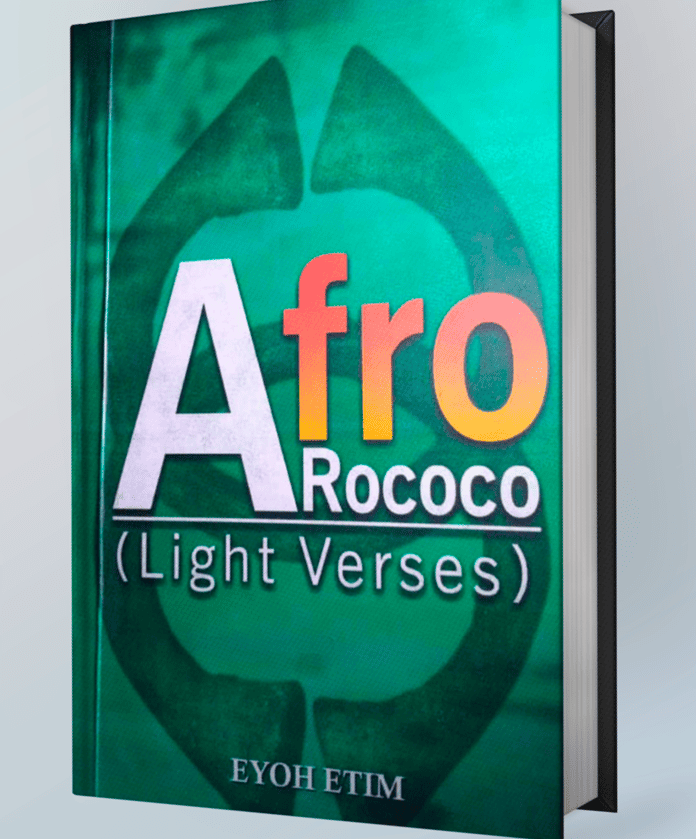
Eyoh Etim’s poetry collection, Afro Rococo (Light Verses), is not your traditional, sprawling, heavy poetry book. It is a sharp, witty, and deeply thought-provoking collection of 105 poems that you can read almost as quickly as you scroll through your social media feed. The poet, no doubt, created something truly unique here.
To understand this book, we have to understand its title. “Rococo” refers to an 18th-century European art style characterised by extreme lightness, beauty, decoration, and a playful form. Etim takes this delicate, epigrammatic poetic style and crashes it into the “heavy and hefty” realities of postcolonial Africa and our fast-paced, postmodern digital world.
The poet actually describes his poetry as a “meme of human realities.” He designed these brief poems to mimic the fleeting ephemerality of platforms like Twitter and TikTok. He wants you to read a verse, let the wit hit you for a moment, and then pass on to the next one. In other words, the kind of poems in this collection can be said to mirror how we consume information today.
One of the most striking aspects of this collection is how funny it is, despite tackling very depressing subjects. Etim argues that because traditional solutions to human suffering have failed, humanity must rely on sarcastic laughter, dark humour, and lampoons to cope.
He uses this humour to expose political hypocrisy. A perfect example is the poem, “The corn eaters.” Here, Etim mocks “political comedians” who eat roasted corn by the roadside during election campaigns to trick the masses into thinking they are poor. The punchline? These same politicians spend the rest of their four years in office snacking on “corned beef.”
As you read through Afro Rococo, you’ll notice Etim organises his “light verses” around several major pillars of modern life. One is the agony of the postcolony. He paints a tragic picture of the African working class and exploitation. In “The fisherman’s song”, we follow a man who paddles against the tide to throw his net into a “polluted sea,” but he catches nothing but a dirty net. He goes home empty-handed, gets extorted by a corrupt official, and fights with his hungry wife while the “gods laugh from a distance.” He also critiques Africans fleeing to the West in “We go there to die.” According to him, these fleeing Africans mortgage their homeland’s treasures for “dollar-crumbs” only to become “two-headed masquerades.”
Another pillar of modern life accurately represented in the collection is the postmodern/digital reality. Etim brings poetry into the 21st-century workplace and digital sphere. He compares a toxic work environment to “trying to relax on a chair cushioned with needles.” In a brilliant ode to the mobile phone, “You hold him in your hands,” he categorically shows how the device is simultaneously our greatest ally, a tool that projects our image, and a spy that “rules your whole life.”
The book is also cynical about human relationships. In “The happy prisoner’s song,” the poet humorously equates marriage to a literal prison. He argues that friendless solitude is better than the “nagging noise” of a partner who wants either your money or your soul. He also repeatedly warns readers about false friends and sycophants who “flatter you in your presence but demonise you in your absence” in “They are not your friends.” Yet, amidst this cynicism, he leaves room for genuine affection with his declaration that women are the “Salt” of the earth.
Then, there is an overarching motif of grief in the poetry collection. The book mourns real loss. The poet offers a moving tribute to the late actor Chadwick Boseman whom he celebrates as a hero who taught the world the “glory of black pride” in “A Threnody for Boseman.” He also questions the unfairness of death in “The cruel Reaper.” He questions why death plucks the “unripe” young and spares the old. In his words:
The cruel Reaper plucks the best and spares the
worst.
The cruel Reaper picks the unripe
and venerates the rotten-ripe.
Dr. Eyoh Etim also uses the poetry collection to examine the role of a poet in a broken society. The collection’s stance is clear. The role of a poet is to speak truth to power. This is clearly articulated in “What is art?” where the speaker questions the value of poetry if it is not used to shatter neo-colonial chains or if it is sold out for “worthless naira notes.” The poet does not stop there. There is clearly a reward for poetic integrity as depicted in “The Poet at Heavens gate,” where a poet is granted entry to paradise because he never sold his pen to the highest bidder, but rather used it to defend the poor. But who is a poet without his poetry? With this in mind, Etim defines the creative process of poetry in “Poetry is the.” Here, he defines poetry as the art of capturing in words what the mind has perceived in pictures.
Afro Rococo (Light Verses) by Eyoh Etim is thus a masterclass in contrasts. It takes the crushing weight of poverty, betrayal, existential pain, and bad governance, and wraps them in delicate, witty, and digestible verses. It asks us to look at the darkest parts of our society, but gives us the gift of laughter to help us survive the view. Finally, I leave you these two brilliant, bite-sized moments (one on false leadership, the other on resilience) from the collection to give you a taste of the poet’s epigrammatic style:
1
The Vulture thinks that he is smart
and that's the reason why
he always sits atop the tree
to spew out lies upon lies.
2
With the stones
that Life has
thrown at me,
I have built
a mansion of
verses.
To get your copy of Afro Rococo, kindly go to the official website of Planeyo Publishers. The purchase link is in the “Buy now” button below.
Receive Literary Updates through our Social Media Channels:
- WhatsApp: Literature PADI or Literature-in-English with LP
- Telegram: Literature PADI
- YouTube: @literaturepadi
- Facebook: Literature PADI