Download our SSCE Study Guide Bundle
The themes in Harper Lee’s To Kill A Mockingbird include racial injustice, moral growth, courage, hypocrisy, childhood innocence versus adult obfuscation, good versus evil, religious extremism, racial prejudice, compassion, social hierarchy, appearance versus reality, parental neglect versus love, gender expectations, and defective institutional education.
In this section, we are going to discuss these themes in To Kill A Mockingbird by Harper Lee.
Theme of Racial Injustice
The theme of racial injustice is examined through the deeply entrenched systemic segregation and the impossible survival choices forced upon Maycomb’s Black citizens. To begin with, spatial segregation dictates the physical boundaries of the town. During the trial, the Black community must wait patiently for the white people to enter the courthouse first, before being relegated to the Colored balcony.
Furthermore, Tom Robinson’s tragedy is rooted in a racially motivated catch-22. As Atticus notes, Tom was in an impossible predicament: he would not dare strike a white woman under any circumstances and expect to live long, so his only option was to run, an action that the prejudiced society automatically interprets as a sure sign of guilt. Tom attempts to articulate this terrifying reality on the stand, telling the prosecutor, “if you was a nigger like me, you’d be scared, too.”
The injustice extends far beyond the courtroom. It haunts the daily life of Tom’s widow, Helen, who is forced to walk nearly a mile out of her way to avoid the public road because the Ewells “chunked at her.” This proves that the racial hierarchy empowers even the lowest-class white citizens to terrorise innocent Black individuals with impunity.
Theme of Moral Growth
The theme of moral growth is explored through Jem’s painful transition from childhood idealism to deep disillusionment. His maturation is agonising rather than triumphant. This is evident in his physical reaction after the guilty verdict. He grips the balcony rail until his hands are white, his shoulders jerking as if each “guilty” is a separate stab. His reaction marks the violent death of his naive belief in the goodness of his neighbours.
He weeps and mutters “It ain’t right,” as he realises that the law does not protect the innocent. Jem later articulates this painful awakening through a poignant metaphor, stating that growing up in Maycomb is “like bein’ a caterpillar in a cocoon… I always thought Maycomb folks were the best folks in the world.”
His moral growth forces him to desperately try to categorise the town’s fractured society into “four kinds of folks.” This heavy burden of awareness leads Jem to a dark epiphany regarding their reclusive neighbour. He realises that Boo Radley has stayed shut up in his house for twenty-five years simply “because he wants to stay inside” to avoid the cruelty and senseless hatred of the world.
Theme of Courage
The theme of courage is primarily associated with Atticus taking the case of Tom Robinson even at the cost of his life and the endangerment of his family. However, this theme manifests in several other ways in the novel. The text highlights the unsung, quiet courage of those who subtly defy social norms or face personal ruin with grace.
Mr. Link Deas, for example, exhibits immense moral courage by risking his reputation and disrupting the deeply prejudiced courtroom to loudly declare, “That boy’s worked for me eight years an’ I ain’t had a speck o’trouble outa him.” Similarly, Judge Taylor demonstrates a subversive form of bravery. As Miss Maudie points out, it was no accident that the judge appointed Atticus to defend Tom Robinson; he deliberately passed over the junior lawyer who usually took such cases because he knew Atticus was the only man in those parts who could keep a jury out for hours, and force the town to take a “baby-step” towards true justice.
Miss Maudie Atkinson herself embodies a profound, resilient courage. When her beloved home burns to the ground, she refuses to grieve or play the victim. Instead, she greets the devastation with an optimistic grin. She cheerfully declares she always wanted a smaller house so she could have more room for her azaleas.
Theme of Hypocrisy
The theme of hypocrisy is examined through Maycomb’s collective performance of morality and its tendency to quietly outsource its conscience. The town’s religious elite, in persons of Mrs. Merriweather and Mrs. Farrow, perfectly embody this performative piety. They eagerly weep for the souls of the African Mruna tribe while simultaneously expressing intense, unchristian disdain for their own Black neighbours and servants.
More profoundly, the town collectively practices a quiet hypocrisy by secretly relying on Atticus Finch to uphold the moral standards they are too afraid to defend themselves. As Miss Maudie acutely observes, the citizens of Maycomb pay Atticus the “highest tribute” by trusting him to do the right thing, yet they hypocritically allow him to wreck his health and endure the town’s public scorn to accomplish the “unpleasant jobs” they are too cowardly to handle.
Get the Full Analysis in PDF
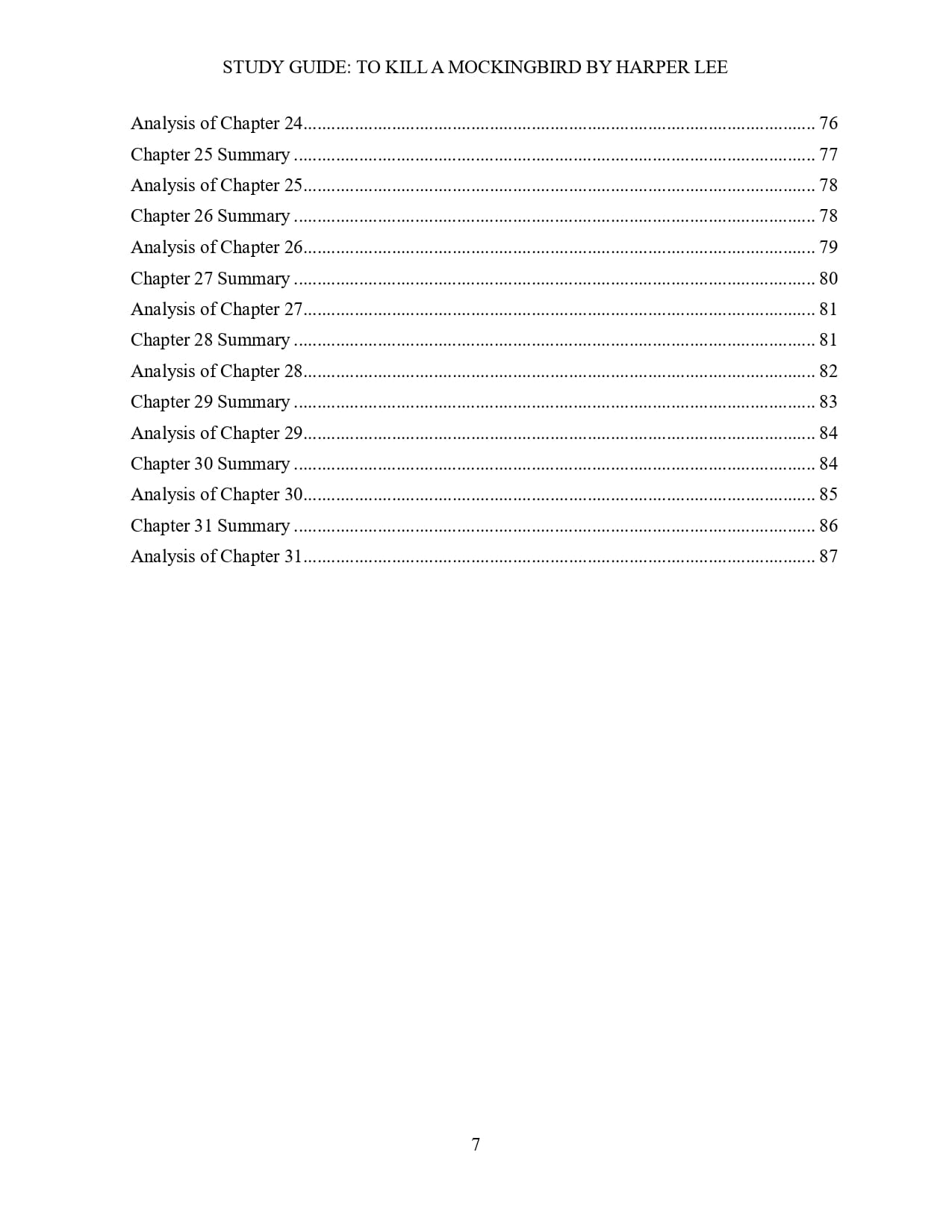
Enjoying this breakdown? What you’re reading is just part of the full experience. The premium PDF edition brings everything together in one seamless, distraction-free document that has the background, setting, plot summary, chapter-to-chapter summary and analysis, narrative devices, characters, and themes. If you’re studying seriously, this is the version you’ll want.


Theme of Childhood Innocence vs. Adult Obfuscation
The novel positions childhood instinct as a raw, physical moral compass that detects systemic cruelty before adult society can obfuscate it with rationalisations. During Tom Robinson’s trial, Dill is overcome by the hateful, sneering way the prosecutor addresses Tom as “boy.” He is physically sickened by the injustice that he bursts into tears and must leave the courtroom.
Mr. Dolphus Raymond explains this phenomenon directly to the children. He tells them that Dill’s pristine “instinct” hasn’t yet caught up with the adult world’s bitter compromises. Raymond predicts that as Dill grows older and absorbs the town’s bigoted norms, he will lose this pure sensitivity and no longer cry at the “simple hell white people give colored folks” without even thinking. This entirely underscores Atticus’s tragic realisation following the trial: when the adults of the town perpetuate their deeply ingrained racial prejudices, it “seems that only children weep.”
Theme of Good vs. Evil
The narrative subverts traditional representations of good and evil by demonstrating that true evil often resides not in obvious, grotesque villains, but in the polite, everyday complicity of “reasonable” people. While Bob Ewell represents overt malice, Atticus points out that a much more pervasive evil is committed by the twelve “reasonable men” on the jury who willingly allow their racial resentments to overcome their sense of justice. The deeply ingrained bigotry of Maycomb acts as a corrupting force that makes otherwise rational men “lose their heads” and commit systemic violence by convicting an innocent man simply because of his skin colour.
Conversely, the novel places its most profound force for good within the town’s most feared outcast, Boo Radley. Initially mythologised by the community as a “malevolent phantom” responsible for local morbid events, Boo emerges from the darkness to perform the ultimate act of goodness by saving the Finch children’s lives. Scout’s final realisation cements this subversion of expectations; echoing the plot of the children’s book The Gray Ghost, she realises that when you finally uncover the truth about people whom society has villainised, “most people are… real nice.”
Theme of Religious Extremism
The novel explores how rigid, fundamentalist extremism destroys the human spirit and breeds cruelty. This is starkly illustrated through the “foot-washing Baptists,” a sect that believes any form of pleasure is a sin. These extremists use their interpretation of the Bible to judge and condemn others, vividly demonstrated when they emerge from the woods to tell Miss Maudie that she and her flowers are going to hell because she spends time in “God’s outdoors” instead of inside reading the Bible.
Miss Maudie provides a profound insight into this extremism. She tells Scout that “sometimes the Bible in the hand of one man is worse than a whiskey bottle” in the hands of a decent man, because these zealots are so “busy worrying about the next world they’ve never learned to live in this one.”
The most tragic consequence of this religious severity is Mr. Radley. He is described as a man so upright he “took the word of God as his only law.” His joyless, unyielding fanaticism leads him to view the state industrial school as a disgrace. It prompts him to cruelly lock his own son, Boo, inside their house for decades.
Theme of Racial Prejudice
To Kill A Mockingbird presents racism as an ingrained, blinding societal sickness, what Atticus famously calls “Maycomb’s usual disease.” This disease strips away logic and causes otherwise reasonable, fair-minded people to go “stark raving mad when anything involving a Negro comes up.” Atticus explicitly breaks down this phenomenon to Jem following the trial. He explains that in their world, there is “something that makes men lose their heads—they couldn’t be fair if they tried.”
The novel highlights how this systemic prejudice allows the absolute lowest members of white society, the Ewells, who live like animals in squalor behind the town dump, to wield life-or-death power over a respectable, hardworking Black man. Atticus points out to the jury that the prosecution relies entirely on the “evil assumption—that all Negroes lie,” knowing the all-white jury will allow their racial resentments to overcome the overwhelming physical evidence of Tom Robinson’s innocence.
Theme of Compassion
The novel portrays true compassion as a perilous, socially subversive choice. The most devastating example is Tom Robinson, who makes the fatal mistake of admitting on the witness stand that he did chores for Mayella Ewell without pay because he “felt right sorry for her.” In the rigid caste system of the Jim Crow South, a Black man daring to feel pity for a white woman is viewed as an unforgivable insult, and this genuine moment of compassion instantly turns the entire courtroom against him.
Conversely, compassion requires Sheriff Heck Tate to subvert the law to protect the innocent. Knowing that Boo Radley is painfully shy, Mr. Tate adamantly refuses to arrest him or expose him to the town’s overwhelming gratitude for killing Bob Ewell. He deliberately falsifies the official report, with his insistence that Ewell “fell on his knife” because he believes that dragging a quiet hero into the limelight is a profound sin.
Finally, Atticus instils this subversive compassion in his children. He repeatedly teaches Scout the foundational lesson to never judge a person until she “climb[s] into his skin and walk[s] around in it,” an ideal that culminates in his gentle, unwavering belief that “most people are [nice], Scout, when you finally see them.”
There are 937 words waiting beyond this point.
You’ve just read part of the themes. What follows is a further 937 words that complete this segment. If this portion has been useful so far, the continuation delivers the full thematic analysis. Continue reading to unlock the remaining 937 words.
Related:
- Plot Summary and Setting of To Kill A Mockingbird by Harper Lee
- Characters in To Kill A Mockingbird by Harper Lee
- Narrative Devices in To Kill A Mockingbird by Harper Lee
- Study Guide: To Kill A Mockingbird by Harper Lee
Receive Literary Updates through our Social Media Channels:
- WhatsApp: Literature PADI or Literature-in-English with LP
- Telegram: Literature PADI
- YouTube: @literaturepadi
- Facebook: Literature PADI